Копилочка
EN
Open in browser

iPhone app and website

Money tracking in any currency

Pay in baht, euros or pesos and log it as is. Kopilochka converts it to your currency and answers three questions your bank can't: how long would my money last, how much do I have in total, and how much can I spend today.

Pay in baht, euros or pesos: log it as is. Free, no ads, no bank connection.

Coming soon to theApp StoreOpen in browser

Free. No account, no ads, no bank connection.

On the App Store October 31
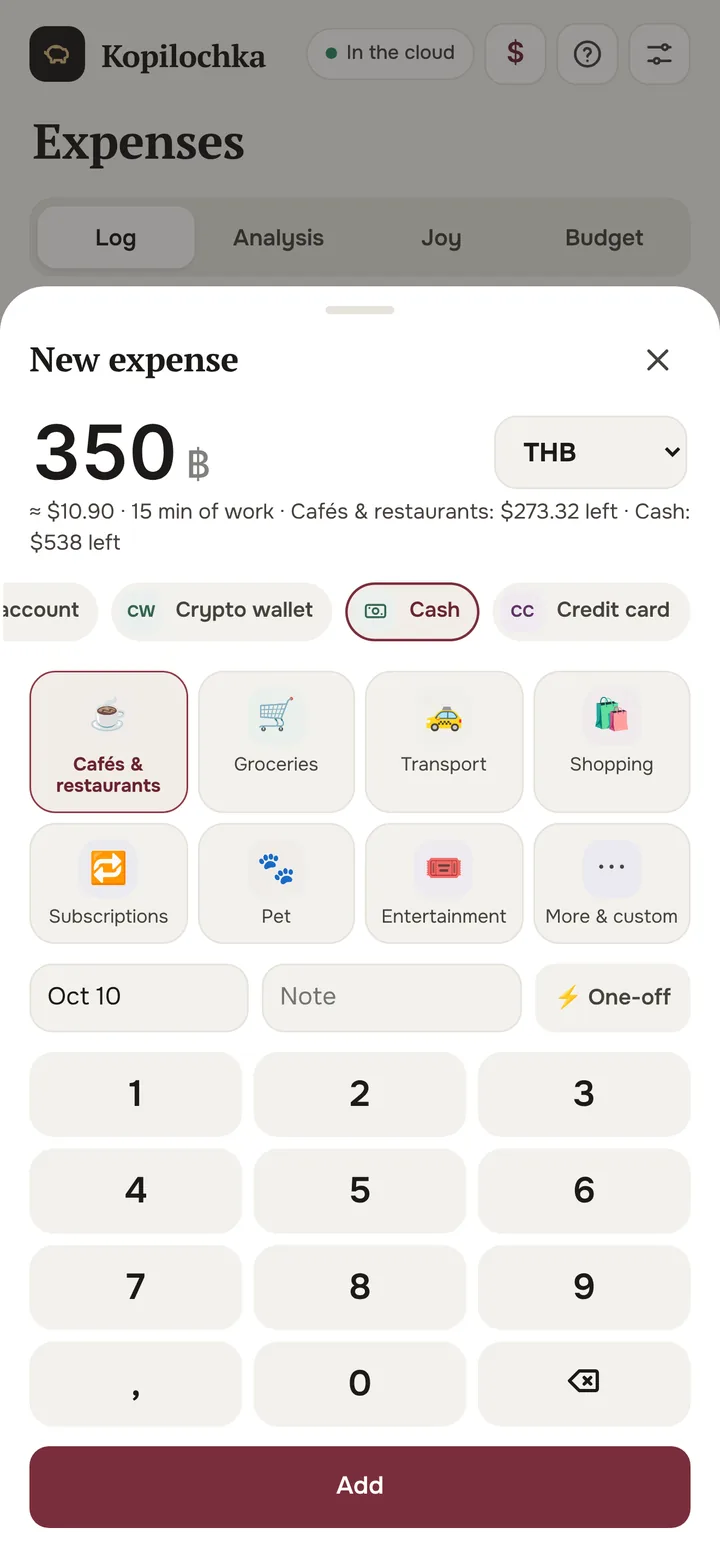
New expense of 350 baht converted to dollars
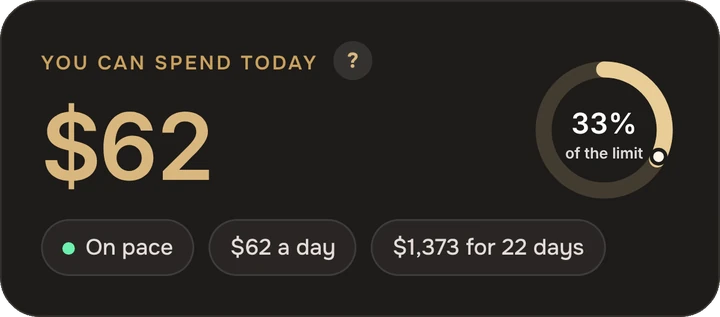
You can spend today
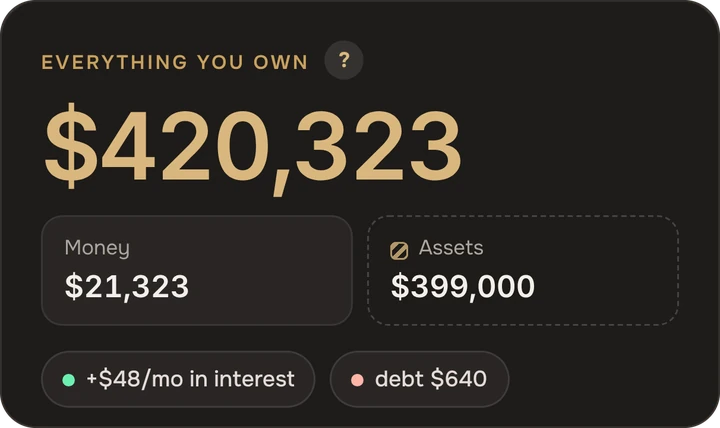
How much do I have in total

Coming to the App Store

Apple has already approved Kopilochka. It lands in the App Store on October 31: set a reminder so you don't miss it.

00000000
days
00000000
hours
00000000
minutes
00000000
seconds

Launching today

Kopilochka will appear in the App Store later today. The link will be here and in the Telegram channel.

Three questions your bank doesn't answer

How long would my money last

Your emergency fund is built from real expenses. See how many months and years you'd last if your income stopped.
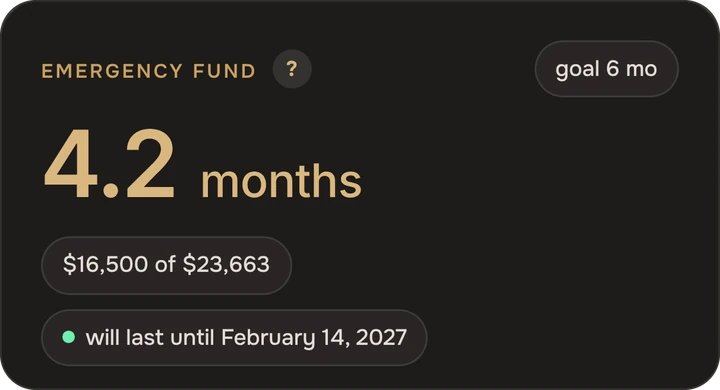
How long would my money last

How much do I have in total

Accounts, cash in several currencies, crypto, deposits, debts, even a car and an apartment: one number at today's rates.

How much do I have in total

How much can I spend today

Set a budget for flexible spending; Kopilochka splits it by day and recalculates after every purchase.

How much can I spend today

Pay in baht, see it in your currency

Log an expense as it is, in the currency you paid in. Kopilochka converts it at today's rate and shows your totals in your own currency. Over 60 currencies plus crypto.

Sample rates. In the app they update every time you open it.

Café in Bangkok

฿350

≈$10.90

What's inside

How many years your money lasts

Rent, food, bills: your emergency fund is calculated from them. See how many months and years your money covers if income stops, and what changes if you sell the car.
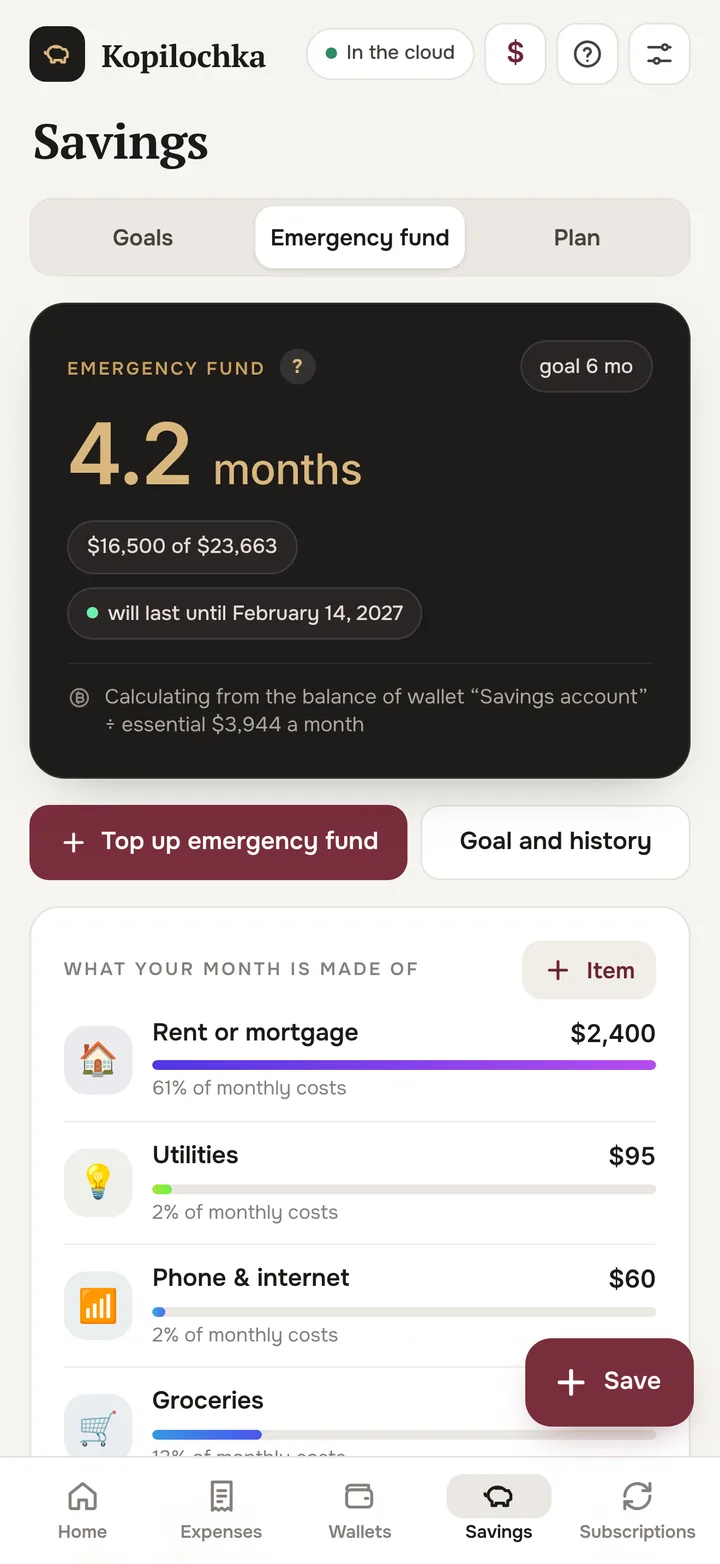
Emergency fund screen: how many years your money lasts

Everything you own in one number

A card in dollars, cash in baht, a deposit in euros, bitcoin on an exchange, an apartment and a car. Kopilochka adds it all up into one net worth at today's rates and shows what it's made of.
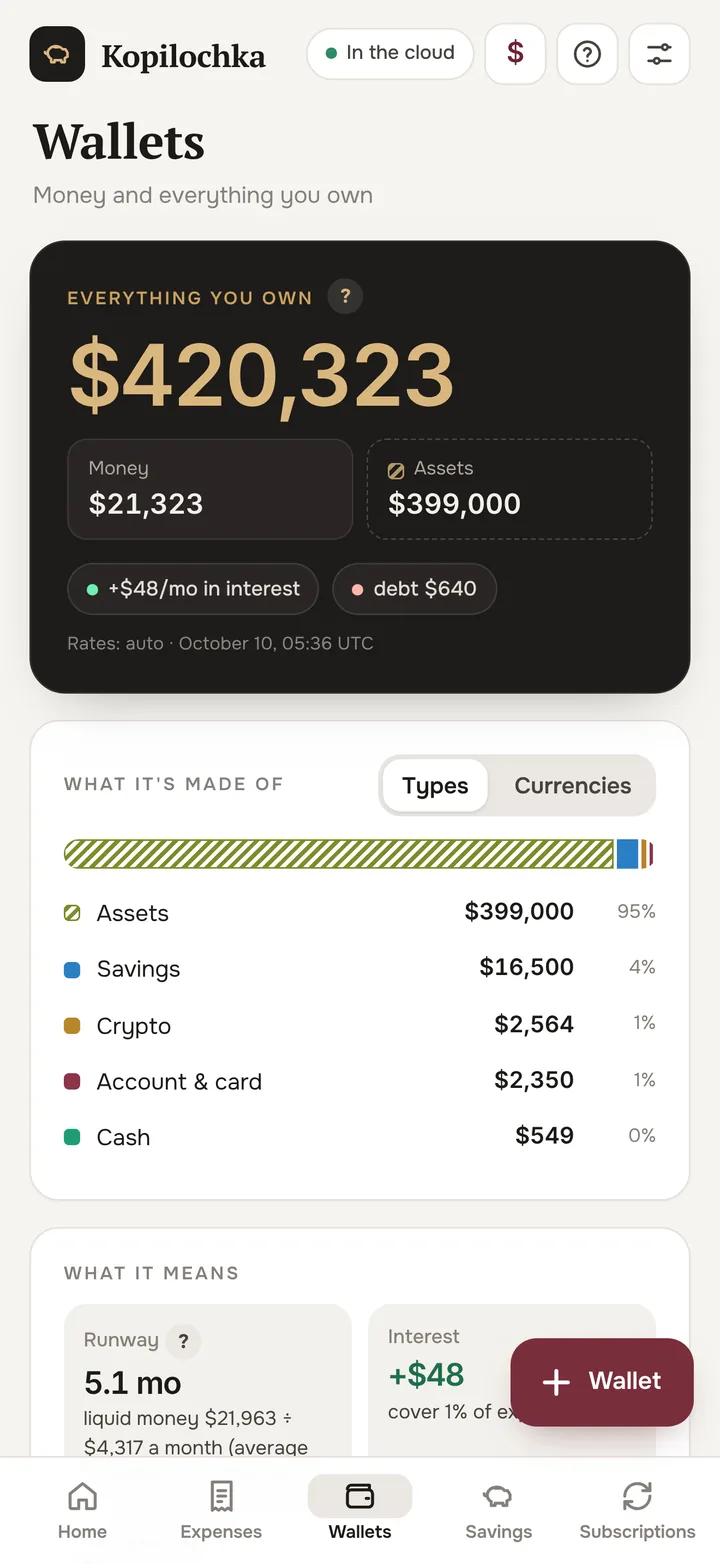
Wallets screen: net worth and its breakdown

A daily limit

The main number on screen is how much you can spend today. Spend more and tomorrow's limit drops. You see it right away, not at the end of the month.
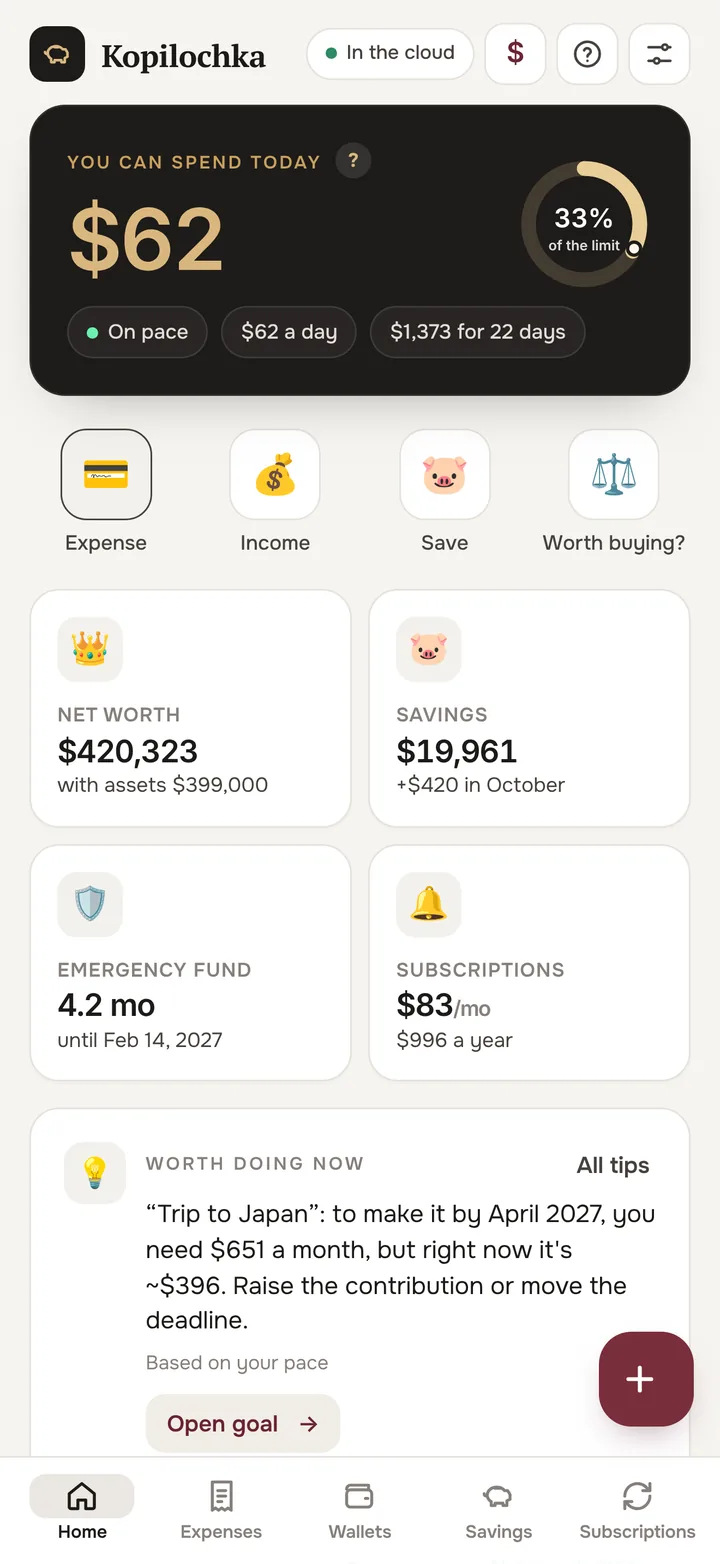
Home screen: how much you can spend today

Piggy bank and goals

A monthly plan, a contribution on payday, a streak of months with no gaps. Goals in any currency or crypto. A "don't touch until" lock, if you know you raid your savings.
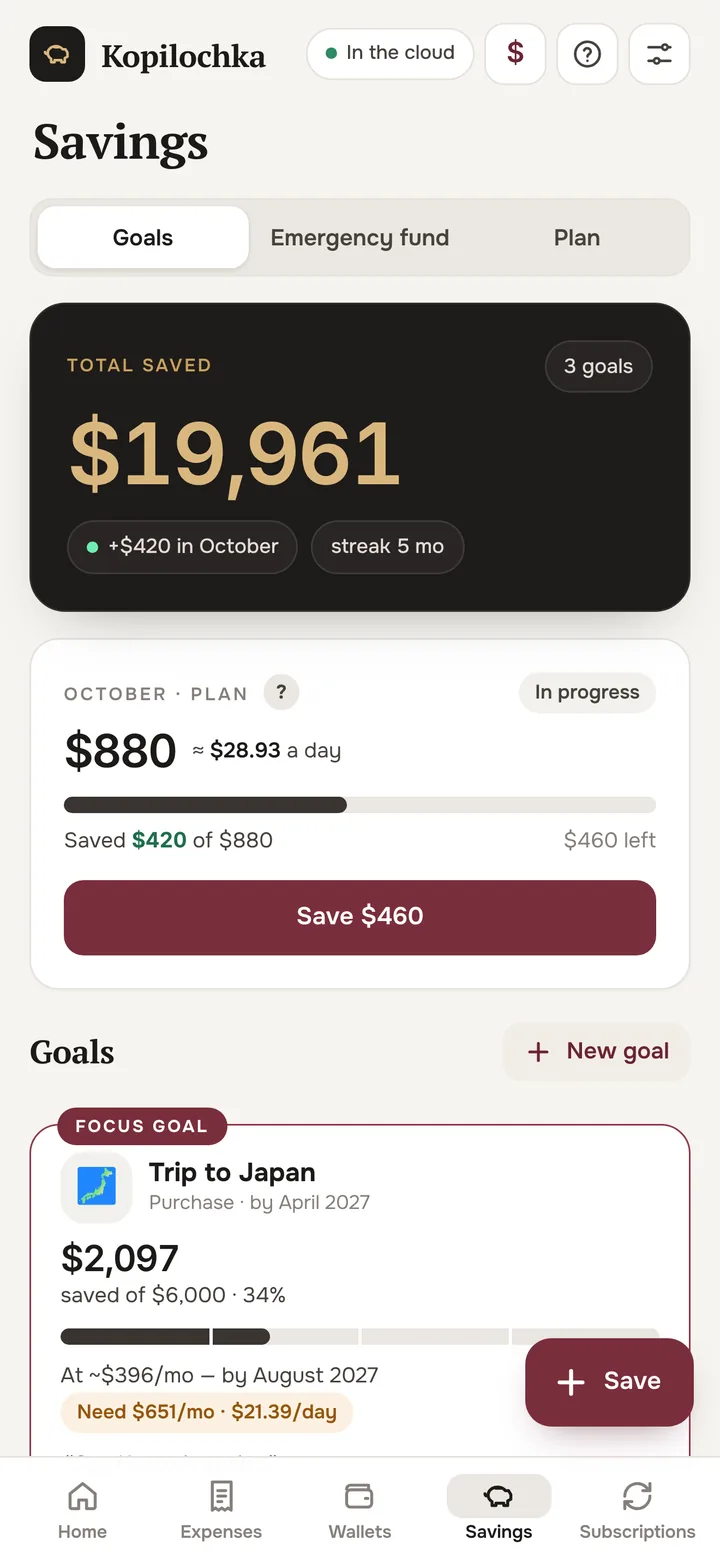
Savings screen: monthly plan and goals

Joy of spending

A couple of days after a purchase Kopilochka asks: was it worth it? Rate it from 😞 to 😄 and over six months see how much went to waste and what makes you happier: things or experiences.
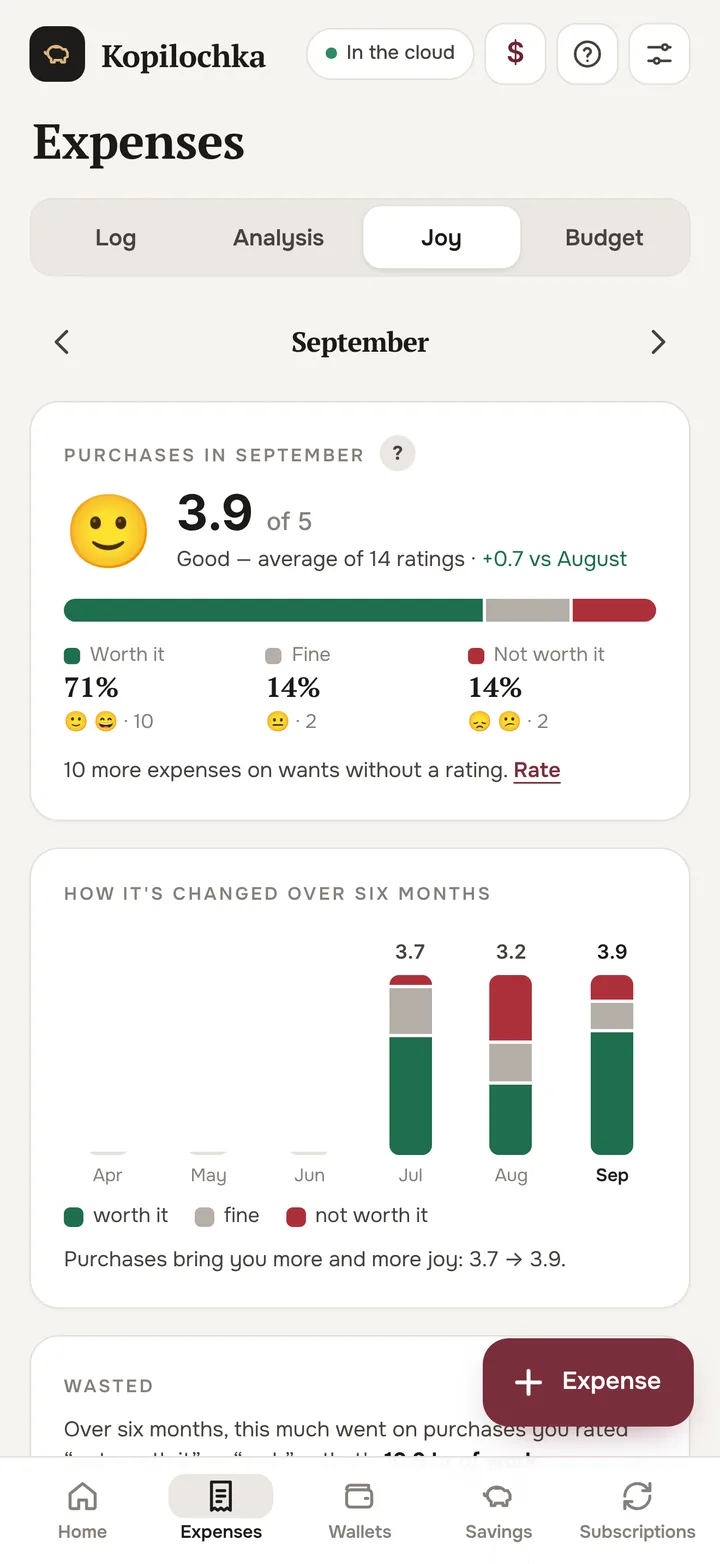
Joy screen: purchase ratings for the month

Face ID and only the notifications that matter

Without Face ID the app won't open even on an unlocked phone, and balances are hidden in the app switcher. Notifications only when money is at stake: a credit card payment, a free trial ending, a tax due date, payday. At most one a day, never at night.
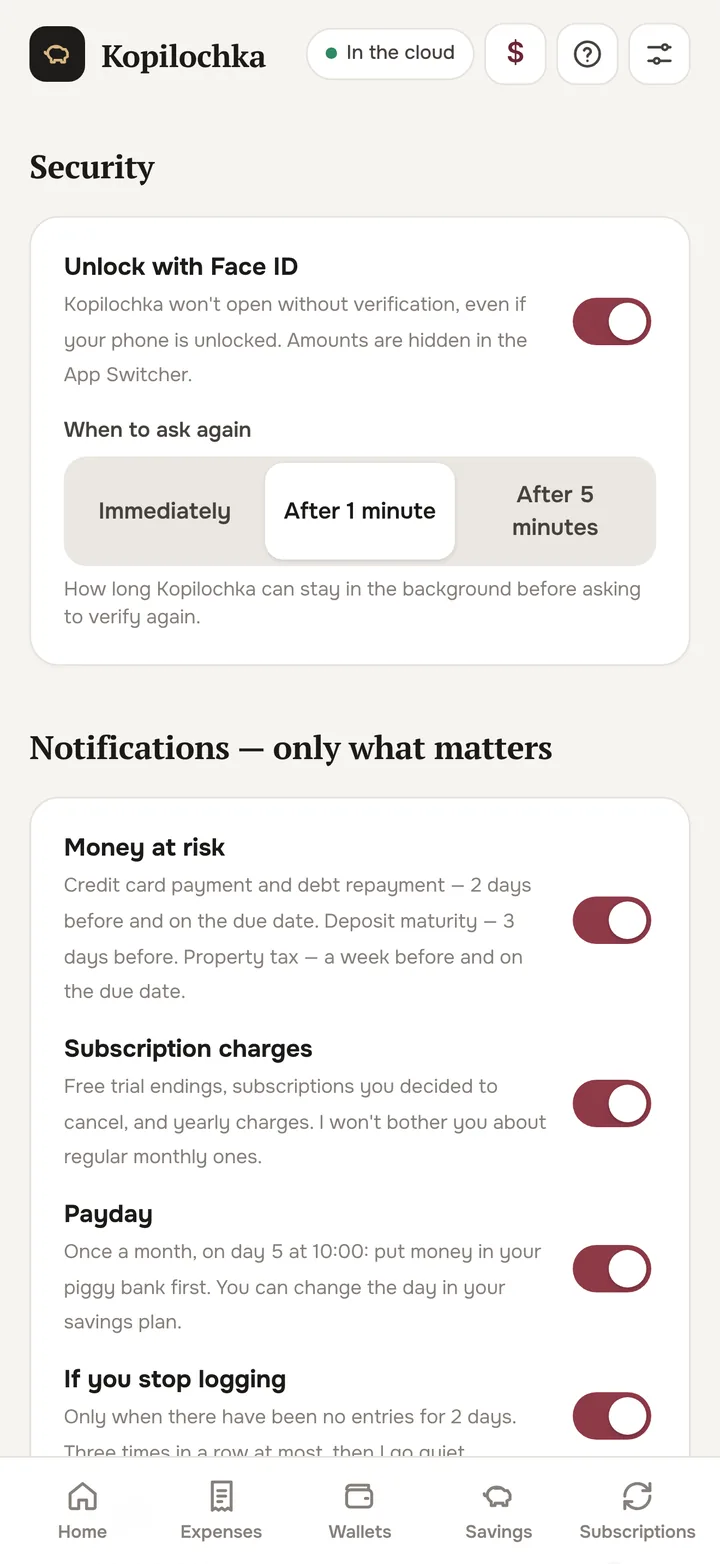
Settings: Face ID and notifications

Try it right here

Kopilochka's two key calculations, with sample numbers.

How much you can spend today

You can spend today
$62
33%of the limit
On pace$62 a day$1,373 for 22 days

Tap the expenses: the limit recalculates instantly, just like in the app.

How long your money will last

Lasts for4.2

In the app, your emergency fund is calculated from your real expenses: rent, food, bills.

No magic here. Only research.

Inside are 29 behavioral economics studies, from 1991 to 2022. Every feature explains why it works and links to the source. Here are all 29.

29studies
×4more people save when the amount is framed per day, not per month
+82%more savings in a year on an account locked until a date
Habit№ 01 37% → 86%Automation beats motivationWhen saving was switched on automatically, participation rose from 37% to 86%.In Kopilochka: The plan is tied to the day money comes in; income gets split right awayMadrian & Shea, 2001, Quarterly Journal of EconomicsHabit№ 02 ×4A daily amount, not a monthly one$5 a day instead of $150 a month, and 4 times as many people signed up to save.In Kopilochka: Next to each contribution: its daily equivalentHershfield, Shu & Benartzi, 2020, Marketing ScienceHabit№ 03 3.5% → 13.6%Save More TomorrowAgreeing in advance to raise contributions as income grows nearly quadrupled the savings rate in 40 months.In Kopilochka: Contribution auto-increaseThaler & Benartzi, 2004, Journal of Political EconomyHabit№ 04 d = 0.65If-then planA meta-analysis of 94 studies: a trigger and action set in advance noticeably raise the chance of following through.In Kopilochka: An if-then plan in every goalGollwitzer & Sheeran, 2006Habit№ 05 66 daysOne miss is no big dealA habit forms in 66 days on average, and missing once barely matters: a streak of misses does the damage.In Kopilochka: Streak and the “never miss twice” tipLally et al., 2010, European Journal of Social PsychologyHabit№ 06 138 studiesTracking changes behaviorA meta-analysis of 138 studies and nearly 20 thousand people: regularly monitoring progress raises the chance of reaching a goal.In Kopilochka: Two-tap expenses, streak, weekly reviewHarkin et al., 2016, Psychological BulletinHabit№ 07 34% vs 19%Endowed progressA loyalty card with two stamps already on it was completed by 34% of people, an empty one by 19%, even though the number of steps was the same.In Kopilochka: A starter checklist with the first step already doneNunes & Drèze, 2006, Journal of Consumer ResearchGoals№ 08 10.5% vs 3.5%One goal beats fiveFamilies with one goal saved about 10.5% of income versus 3.5% in the control group.In Kopilochka: Focus goalSoman & Zhao, 2011, Journal of Marketing ResearchGoals№ 09 +15.5%A reminder about a specific goalReminders that named the goal increased savings by 15.5%; without the name, they barely had an effect.In Kopilochka: A “why this goal matters to me” fieldKarlan et al., 2016, Management ScienceGoals№ 10 +82%Lock the moneyAn account you can't withdraw from before the deadline increased savings by 82% in a year.In Kopilochka: “Don't touch until” lockAshraf, Karlan & Yin, 2006, Quarterly Journal of EconomicsGoals№ 11 50%The dangerous middleMotivation dips in the middle. At the start, “how much you already have” helps; near the end, “how much is left”.In Kopilochka: After 50%, the goal shows what's leftBonezzi, Brendl & De Angelis, 2011, Psychological ScienceGoals№ 12 day 1 of the monthThe fresh start effectAfter “temporal landmarks” (the start of a month, a week, a birthday) people are more likely to take on goals.In Kopilochka: At the start of the month Kopilochka offers to raise your planDai, Milkman & Riis, 2014, Management ScienceGoals№ 13 ×2 in 10 yearsCompound interest is underestimatedPeople consistently underestimate compound interest, and save less. At 7% a year, money doubles in about 10 years.In Kopilochka: The calculator splits the result into contributions and interestStango & Zinman, 2009, Journal of FinanceEmergency fund№ 14 $250–749A small emergency fund already worksFamilies with even this much are less likely to miss housing payments or face eviction after losing income.In Kopilochka: Emergency fund from real expenses, with milestonesUrban Institute (McKernan et al.), 2016Emergency fund№ 15 No barriersYour emergency fund shouldn't be sacredPeople take out expensive loans just to avoid touching their “responsible” savings, and overpay.In Kopilochka: Emergency withdrawals from the emergency fund: no barriersSussman & O'Brien, 2016, Journal of Marketing ResearchEmergency fund№ 16 25×Rule of 4%Net worth of 25 years of expenses has historically let people withdraw about 4% a year for 30 years straight.In Kopilochka: Financial independence scale in WalletsTrinity Study: Cooley, Hubbard & Walz, 1998Expenses№ 17 −11.6%Tracking cuts the excessAfter installing a tracking app, discretionary spending fell by 11.6%, clothing by 23%, entertainment by 20%. The effect lasted a year.In Kopilochka: Needs and wants, focus on flexible spendingLevi & Benartzi, «Mind the App»Expenses№ 18 $100 → $7Three reasonsPeople underestimate their spending by about $100 a week. Naming three reasons why the week will be unusual cuts the error to $7.In Kopilochka: Monthly plan with three reasons and a bufferHoward, Hardisty, Sussman & Lukas, 2022, Journal of Marketing ResearchExpenses№ 19 ⚡“Exceptions” are the ruleRepairs, gifts, doctor visits feel unique, so people spend more on them than planned.In Kopilochka: “One-off” tag and average bufferSussman & Alter, 2012, Journal of Consumer ResearchExpenses№ 20 ×2The pain of payingWith a card, people were willing to pay about twice as much for the same tickets as with cash.In Kopilochka: Every expense entered by hand, with its price in life: hours of work, days of income or days of lifePrelec & Simester, 2001, Marketing LettersExpenses№ 21 $1/dayPennies a daySmall recurring amounts feel insignificant: “$1 a day” feels easier than “$365 a year”.In Kopilochka: Subscriptions per yearGourville, 1998, Journal of Consumer ResearchExpenses№ 22 AlternativeThe forgotten alternativeWhen buying, people don't think about what they're giving up. A reminder of the alternative changes the choice.In Kopilochka: Purchase check: hours of work, goal days, 10 yearsFrederick et al., 2009, Journal of Consumer ResearchExpenses№ 23 48 hThe urge passesThe urge to buy is strongest in the moment and fades with time: delay is one of the main self-control strategies.In Kopilochka: Pause 48 hours or 30 daysHoch & Loewenstein, 1991, Journal of Consumer ResearchExpenses№ 24 PrioritiesCutting entirely beats skimpingGiving up less important things saves more than hunting for cheaper prices. People who budget spend impulsively less often.In Kopilochka: The joy map shows what to cutFernbach, Kan & Lynch, 2015, Journal of Consumer ResearchExpenses№ 25 “Other”Vague categoriesExpenses that are hard to categorize slip out of control.In Kopilochka: A warning when “Other” grows too bigHeath & Soll, 1996, Journal of Consumer ResearchHappiness№ 26 ExperiencesMoney and joyHappiness comes from experiences, buying for others, and things that save time. You quickly get used to stuff.In Kopilochka: Joy rating and the “how much I spend / how much joy” mapDunn & Norton, «Happy Money», 2013Happiness№ 27 ExperienceExperience beats imaginationPast enjoyment predicts the real experience more accurately than trying to imagine it.In Kopilochka: Joy forecast based on your past ratingsGilbert et al., 2009, ScienceHappiness№ 28 No shameThe ostrich effectWhen people expect bad news, they stop looking at their finances, and lose control right when they need it most.In Kopilochka: Overspending means a new limit for tomorrow, not a red screenKarlsson, Loewenstein & Seppi, 2009, Journal of Risk and UncertaintyHappiness№ 29 PurposeMoney with a purposeWhen money is sorted into “envelopes” with a specific purpose, people save it much better.In Kopilochka: Goals, wallets and income splitSoman & Cheema, 2011, Journal of Marketing Research

All 29 sources open right from the app, in the Why section

Aleksandr Romanov: New York
AARO studio · sobral.ai

From the maker

Why Kopilochka exists

I've been tracking my money since I was 16, almost nine years straight. I tried what feels like every tracker out there, and each one was missing something: real multi-currency support, crypto next to cash, or a simple answer to how much I can spend today.

Most of all, I got tired of waiting. You write to developers that something is off, and nothing changes for years. At some point it became clear: time to take it into my own hands and build the app I use myself every single day.

That's why Kopilochka updates around you. Missing a feature, annoyed by a detail, something works the wrong way? Write in the Telegram channel and it will appear in one of the next updates.

Aleksandrmaker of Kopilochka

What are you missing?

Ask for any fix or feature in the channel. The most requested and useful ones ship in the next updates.

Request a change on Telegram

Living between currencies

Every trip added a new currency to my books. That is how Kopilochka came about.

Aleksandr Romanov: New York
New York
Aleksandr Romanov: Kyoto
Kyoto
Aleksandr Romanov: Training to be a pilot
Training to be a pilot
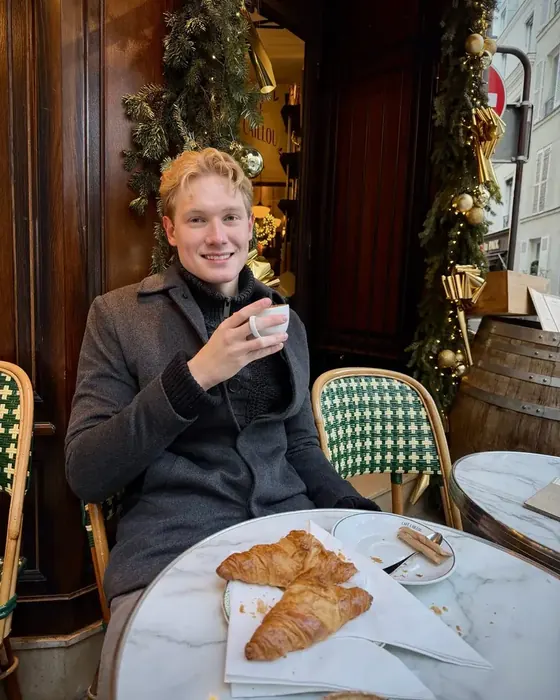
Aleksandr Romanov: Paris
Paris
Aleksandr Romanov: Prague
Prague
Aleksandr Romanov: Rio de Janeiro
Rio de Janeiro
Aleksandr Romanov: On the road with my Samoyed
On the road with my Samoyed
Aleksandr Romanov: Maldives
Maldives

Hi, I'm Aleksandr

I build the apps I was missing myself. I live between countries and currencies, so Kopilochka is first and foremost for people like me: expats, travelers and anyone whose money lives in more than one currency.

  • Nine years of tracking my own money
  • 15 products on sobral.ai, Kopilochka is one of them
  • Web Design Studio Director of the Year, National Business Awards 2023
  • Founded AARO studio, now based in New York

Your data is yours

Free

Expense and income tracking, backup, sync and Face ID are free forever. Everything else is free too, for now.

  • Without an account everything stays on your phone. We receive nothing.
  • Signing in with an email code turns on sync across devices. There is no password.
  • No ads, no trackers. No bank connection needed.
  • Back up to a file. Delete your account with one button.
Privacy policy

14 languages

English, Russian, Ukrainian, Kazakh, Turkish, Spanish, Portuguese, German, French, Chinese, Japanese, Korean, Hindi, Arabic. The interface follows your phone's language.

Used Kopilochka on the web?

In the app tap "Sign in with email" and enter the same address. Expenses, goals and wallets appear on their own. Or open a backup file.

Open the website

Questions

Do I need to sign up?

No. Without an account everything works and stays on your phone. An account is only for sync between devices: sign in with an email code, no password.

Does Kopilochka connect to my bank?

No. You log expenses yourself, in two taps. You see every one of them, and the bank sees nothing.

Where do exchange rates come from?

Fiat from ExchangeRate-API, crypto from Coinbase and CoinGecko. They refresh on every launch; offline, the last rate is used.

What about Android?

There is no Android app. kopilochka.com works in any browser and can be added to the home screen as an app.

Where is my data if I sign in?

In the cloud, in the EU, visible only to you. Deleted together with your account with one button in Settings.

Is this financial advice?

No. Kopilochka is a tracking and planning tool. The decisions are yours.

Start with one expense

Log today's coffee in the currency you paid in.

Coming soon to theApp StoreOpen in browser

Made at AARO studio · New York · since 2020

This site, like Kopilochka itself, was built by Aleksandr Romanov at AARO studio

AARO: websites, identity, 3D and motion

The web design studio of Aleksandr Romanov: founded in 2020, relaunched in New York in 2026. Websites in Russian, English and Chinese, with 3D renders and motion made for each project.

  • Websites
  • Identity
  • 3D
  • Motion
  • RU · EN · 中文
Open the studio site

sobral.ai

I build AI products and show how

15 products by one maker: apps, Telegram bots and work tools. The whole process is public, mistakes included. Kopilochka is one of them.

  • iPhone
  • Web
  • Telegram bots
  • AI
All products

The build process lives in the channel @sobral_ai